

LC75833E Datasheet – 1/3 Duty LCD Display Driver IC
1/3 Duty General-Purpose LCD Display Driver
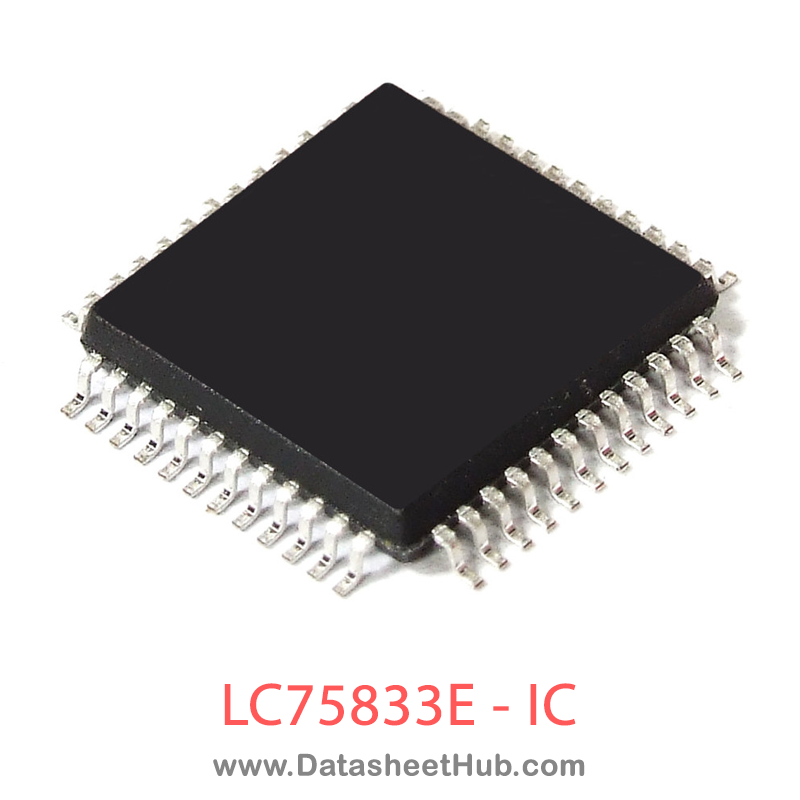
LC75833E overview
The LC75833E is a 1/3 Duty General-Purpose LCD Display Driver made by Sanyo, supplied in these packages: QFP 48, SQFP 48, QFP 44 Type. The absolute maximum ratings table on this page lists the 7 limits from the manufacturer's datasheet that must not be exceeded. This page brings together the LC75833E pinout and maximum ratings, with the full datasheet PDF to preview below or download.
The LC75833E, LC75833W, and LC75833JE are 1/3-duty general-purpose LCD display drivers that can be used for frequency display in electronic tuners under the control of a microcontroller. The LC75833E and LC75833W can drive an LCD with up to 105 segments directly, the LC75833JE can drive an LCD with up to 93 segments directly. The LC75833E and LC75833W and LC75833JE can also control up to 8 general-purpose output ports. Since the LC75833E, LC75833W, and LC75833JE use separate power supply systems for the LCD drive block and the logic block, the LCD driver block power-supply voltage can be set to any voltage in the range 2.7 to 6.0 volts, regardless of the logic block power-supply voltage.
Datasheet
LC75833E features
- Supports both 1/3 duty 1/2 bias and 1/3 duty 1/3 bias LCD drive under serial data control.
- LC75833E, LC75833W: up to 105 segments LC75833JE: up to 93 segments (without the S12, S23, S24, S35 segment output pins from the LC75833E, LC75833W)
- Serial data input supports CCB format communication with the system controller.
- Serial data control of the power-saving mode based backup function and all the segments forced off function
- Serial data control of switching between the segment output port and the general-purpose output port functions
- High generality, since display data is displayed directly without decoder intervention.
- Independent VLCD for the LCD driver block (VLCD can be set to any voltage in the range 2.7 to 6.0 volts, regardless of the logic block power-supply voltage.)
- The INH pin can force the display to the off state.
- RC oscillator circuit
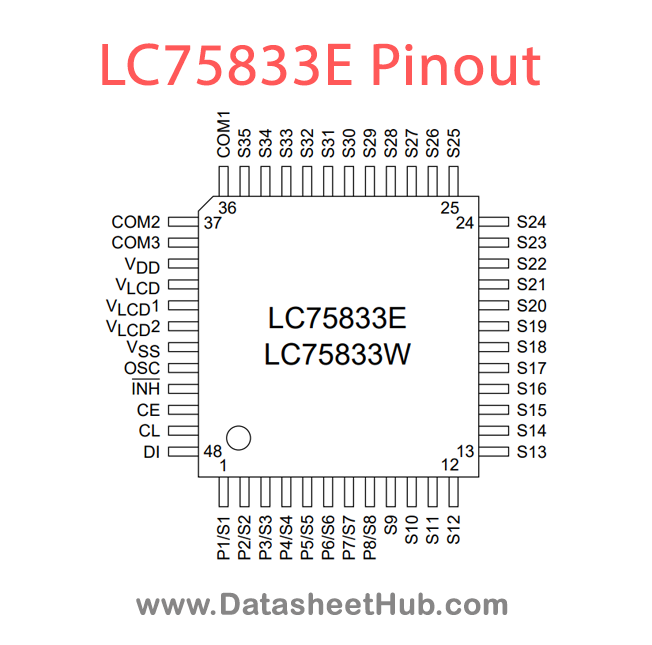
LC75833E pinout
| Pin | Description |
|---|---|
| S1/P1 to S8/P8 S9 to S35 | Segment outputs for displaying the display data transferred by serial data input. The pins S1/P1 to S8/P8 can be used as general-purpose output ports when so set up by the control data. |
| COM1 COM2 COM3 | Common driver outputs. The frame frequency fO is given by: fO = (fOSC/384) Hz. |
| OSC | Oscillator connection An oscillator circuit is formed by connecting an external resistor and capacitor to this pin. |
| CE CL DI | Serial data transfer inputs. These pins are connected to the control microprocessor. |
| INH | Display off control input INH = low (VSS): Off S1/P1 to S8/P8 = Low (These pins are forcibly set to the segment output port function and fixed at the VSS level.) S9 to S35 = Low (VSS), COM1 to COM3 = Low (VSS) INH = high (VDD): On Note that serial data transfers can be performed when the display is |
| VLCD1 | Used to apply the LCD drive 2/3-bias voltage externally. This pin must be connected to VLCD2 when 1/2-bias drive is used. |
| VLCD2 | Used to apply the LCD drive 1/3-bias voltage externally. This pin must be connected to VLCD1 when 1/2-bias drive is used. |
| VDD | Logic block power supply. Provide a voltage in the range 2.7 to 6.0 V. |
| VLCD | LCD driver block power supply. Provide a voltage in the range 2.7 to 6.0 V. |
| VSS | Ground pin. Connect to ground. |
Absolute maximum ratings
| Parameter | Symbol | Value | Unit | Conditions |
|---|---|---|---|---|
| Maximum supply voltage | VDD max | –0.3 to +7.0 | V | VDD |
| Input voltage | VIN 1 | –0.3 to +7.0 | V | CE, CL, DI, INH |
| Output voltage | VOUT 1 | –0.3 to VDD + 0.3 | V | OSC |
| Output current | IOUT 1 | 300 | µA | S1 to S35 |
| Allowable power dissipation | Pd max | 150 | mW | Ta = 85°C |
| Operating temperature | Topr | –40 to +85 | °C | |
| Storage temperature | Tstg | –55 to +125 | °C |
LC75833E applications
- LED Display Drivers
- Automotive Instrument Clusters
- Audio Equipment Panels
- Consumer Electronics
Comments 0
Leave a comment