

MT6323GA Datasheet – Power Management System Chip
Power Management System Chip ( PMIC )
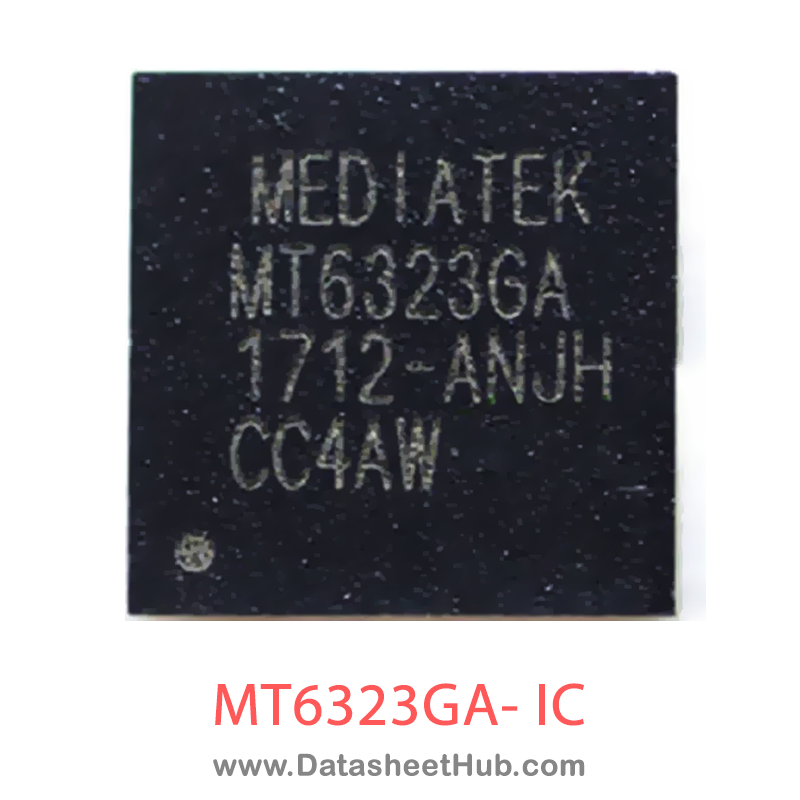
MT6323GA overview
MT6323 is a power management system chip optimized for 2G/3G handsets and smart phones, especially based on the MediaTek MT6572 system solution. MT6323 contains 3 buck converters and 23 LDOs, which are optimized for specific 2G/3G/smart phone subsystems.
MT6323 provides mono 0.7W into 8Ω, high efficiency Class AB/D audio amplifiers and flexibility for various applications of indicator LED drivers. It supports up to 4 channel LEDs with independent controlled. Flexible control includes: register mode, PWM mode and breath mode.
Sophisticated controls are available for power- up, battery charging and the RTC alarm. MT6323 is optimized for maximum battery life. It allows the RTC circuit to stay alive without a battery for several hours. The battery charger in MT6323 supports lithium- ion (Li-ion) battery and provides pre-charge indication. The charger input voltage can be up to 10V and allows USB charging, too.
Some multi-purpose pins enable MT6323 to be configured in various applications.
MT6323 adopts SPI interface and SRCLKEN control pin to control buck converters, LDOs, Class AB/D, various drivers and charger. Besides, it provides enhanced safety control and protocol for handshaking with BB.
MT6323 is available in a VFBGA - 145L package. The operating temperature ranges from -25 to +85°C.
Datasheet
MT6323GA features
- Handles all 2G/3G/smart phone baseband power management
- Input range: 3.4 ~ 4.5V
- 3 buck converters and 23 LDOs optimized for specific 2G/3G/smart phone subsystems
- Full-set high-quality audio feature: Supports uplink/downlink audio CODEC and high-power/quality audio amplifier
- 32K RTC crystal oscillator for system timing, 1.8 and 2.8V clock buffer output
- Multiple function GPIO
- Flexibility for various configurations of indicator LED current source: 4ISINK
- SPI interface
- Li-ion battery charging function
- Over-current and thermal overload protection
- Programmable under voltage lockout protection
- Watchdog timer
- Flexibility hardware PMIC reset function
- Power-on reset and start-up timer
- Precision voltage, temperature, and current measurement fuel gauge
- VFBGA - 145L package
MT6323GA pinout
| Name | Description |
|---|---|
| SYSRSTB | Watchdog reset from AP |
| CHG_DM | USB D- for BC1.1 standard |
| CHG_DP | USB D+ for BC1.1 standard |
| VCDT | Fractional charger input voltage for charger detection |
| VBAT_VPA | Battery power supply input of VPA |
| VPA | SW node of VPA |
| SRCLKEN | 26MHz CLK enable |
| XIN | One of 32K crystal connection port while using crystal to generate 32kHz clock Tie to ground with 32kHz crystal absence |
| XOUT | One of 32K crystal connection port while using crystal to generate 32kHz clock External 32kHz clock input with 32kHz crystal absence |
| DVDD18_IO | Power of VIO18 IO/CORE |
| INT | Default: Output 0 Interrupt to BB, high active |
| DVDD18_DIG | Power of VDIG18 |
| FSOURCE | EFUSE power source |
| AUXADC_AUXIN_GPS | AUXADC input |
| GND_ISINK | GND for ISINK |
| VPROC_FB | Feedback of VPROC |
| VPA | SW node of VPA |
| AVSS28_AUXADC | GND for AUXADC |
| SIM1_AP_SCLK | AP/PMIC SIM1 clock |
| AUD_MISO | Uplink AUDIO ADC serial data |
| SPI_CSN | SPI interface's chip select signal to identify which device is selected |
| SPI_MISO | SPI interface's serial data signal. Default is output only. |
| ISINK3 | Current sink channel 3 output |
| GND_VPROC_FB | Remote sense on ground of VPROC |
Show all 34 pins
| Name | Description |
|---|---|
| VPROC | SW node of VPROC |
| AUXADC_VREF18 | 1.8V AUXADC reference output |
| AVDD33_RTC | RTC LDO output. Supply of RTC macro where backup battery can be added. |
| RTC_32K2V8 | RTC domain 32kHz clock output |
| SIM2_AP_SCLK | AP/PMIC SIM2 clock |
| ISINK1 | Current sink channel 1 output |
| AU_VIN2_N | Analog input 3 negative |
| VPA_FB | Feedback of VPA |
| VPROC | SW node of VPROC |
| AU_VIN2_P | Analog input 3 positive |
MT6323GA applications
- Ideal for power management of 2G, 3G, smart phones and other portable systems.
Comments 0
Leave a comment