

RTL8192ER Datasheet – IEEE 802.11a/b/g/n WLAN Controller
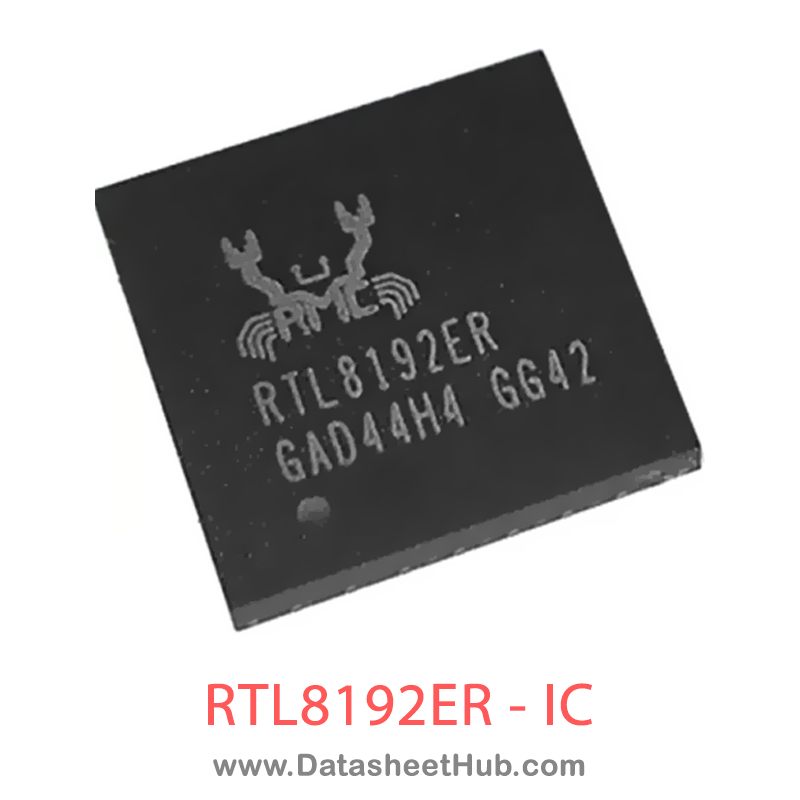
RTL8192ER overview
The RTL8192EU baseband implements Multiple Input, Multiple Output (MIMO) Orthogonal Frequency Division Multiplexing (OFDM) with 2 transmit and 2 receive paths (2T2R) and is compatible with the 802.11n specification. Features include two spatial streams transmission, short Guard Interval (GI) of 400ns, spatial spreading, and transmission over 20MHz and 40MHz bandwidth. The RTL8192EU provides a spatial stream Space-Time Block Code (STBC), Transmit Beamforming (TxBF) and Low Density Parity Check (LDPC) encoding and decoding to extend the range of transmission. At the receiver, extended range and good minimum sensitivity is achieved by having receiver diversity up to two antennas. As the recipient, the RTL8192EU also supports explicit sounding packet feedback that helps senders with beamforming capability. With two independent RF blocks, the RTL8192EU can perform fast roaming without link interruption.
For legacy compatibility, Direct Sequence Spread Spectrum (DSSS), Complementary Code Keying (CCK) and OFDM baseband processing are included to support all 802.11b and 802.11g data rates. Differential phase shift keying modulation schemes, DBPSK and DQPSK with data scrambling capability, are available along with complementary code keying to provide data rates of 1, 2, 5.5 and 11Mbps with long or short preamble. The high-speed FFT/IFFT paths, combined with BPSK, QPSK, 16QAM, and 64QAM modulation of the individual subcarriers and rate compatible punctured convolutional coding with coding rate of 1/2, 2/3, 3/4, and 5/6, provides the maximum data rate of 54Mbps and 300Mbps for 802.11g and 802.11n MIMO OFDM respectively.
The RTL8192EU builds in an enhanced signal detector, an adaptive frequency domain equalizer, and a soft-decision Viterbi decoder to alleviate severe multi-path effects and mutual interference in the reception of multiple streams. For better detection quality, receive diversity with maximal-ratio-combine (MRC) applying up to 2 receive paths are implemented. Robust interference detection and suppression are provided to protect against Bluetooth, cordless phone, and microwave oven interference. Receive vector diversity for multi-stream application is implemented for efficient utilization of MIMO channels. Efficient IQ-imbalance, DC offset, phase noise, frequency offset, and timing offset compensations are provided for radio frequency front-end impairments. Selectable digital transmit and receive FIR filters are provided to meet transmit spectrum mask requirements and to reject adjacent channel interference, respectively.
The RTL8192EU supports fast receiver Automatic Gain Control (AGC) with synchronous and asynchronous control loops among antennas, antenna diversity functions, and adaptive transmit power control functions to obtain the better performance in the analog portions of the transceiver.
The RTL8192EU MAC supports 802.11e for multimedia applications, 802.11i for security, and 802.11n for enhanced MAC protocol efficiency. Using packet aggregation techniques such as A-MPDU with BA and A-MSDU, protocol efficiency is significantly improved. Power saving mechanisms such as Legacy Power Save, U-APSD, and MIMO power saving reduce the power wasted during idle time, and compensate for the extra power required to transmit MIMO OFDM. The RTL8192EU provides simple legacy and 20MHz/40MHz co-existence mechanisms to ensure backward and network compatibility.
Datasheet
RTL8192ER features
- General 56-pin QFN
- 56-pin QFN
- CMOS MAC, Baseband MIMO PHY, and RF in a single chip for 802.11b/g/n compatible WLAN
- Complete 802.11n MIMO solution for
- 2.4GHz band
- 2x2 MIMO technology for extended reception robustness and exceptional throughput
- Maximum PHY data rate up to 144.4Mbps using 20MHz bandwidth, 300Mbps using 40MHz bandwidth
- Compatible with 802.11n specification
- Backward compatible with 802.11b/g devices while operating at 802.11n data rates
- Host Interface
- Complies with USB Specification Revision 2.0
- USB bridge for RTL8761 Bluetooth connection
- Standards Supported
- 802.11e QoS Enhancement (WMM, WMM-SA Client mode)
- 802.11h TPC, Spectrum Measurement
- 802.11k Radio Resource Measurement
- 802.11i (WPA, WPA2). Open, shared key, and pair-wise key authentication services
- MAC Features
- Frame aggregation for increased MAC efficiency (A-MSDU, A-MPDU)
- Low latency immediate High-Throughput Block Acknowledgement (HT-BA)
- Long NAV for media reservation with CF-End for NAV release
- PHY-level spoofing to enhance legacy compatibility
- MIMO power saving mechanism
- Channel management and co-existence
- Multiple BSSID feature allows the RTL8192EU to assume multiple MAC identities when used as a wireless bridge
- Transmit Opportunity (TXOP) Short Inter-Frame Space (SIFS) bursting for higher multimedia bandwidth
- Peripheral Interfaces
- General Purpose Input/Output (16 pins)
- Three configurable LED pins
- Configurable Bluetooth Coexistence Interface
- PHY Features
- 802.11n MIMO OFDM
- Two Transmit and Two Receive path (2T2R)
- 20MHz and 40MHz bandwidth transmission
- Short Guard Interval (400ns)
- Sounding packet
- Low Density Parity Check (LDPC) to enhance link robustness over range
- OFDM receive diversity with MRC using up to 2 receive paths. Switch diversity used for DSSS/CCK.
- Selectable digital transmit and receive FIR filters
- Transmit Beamforming
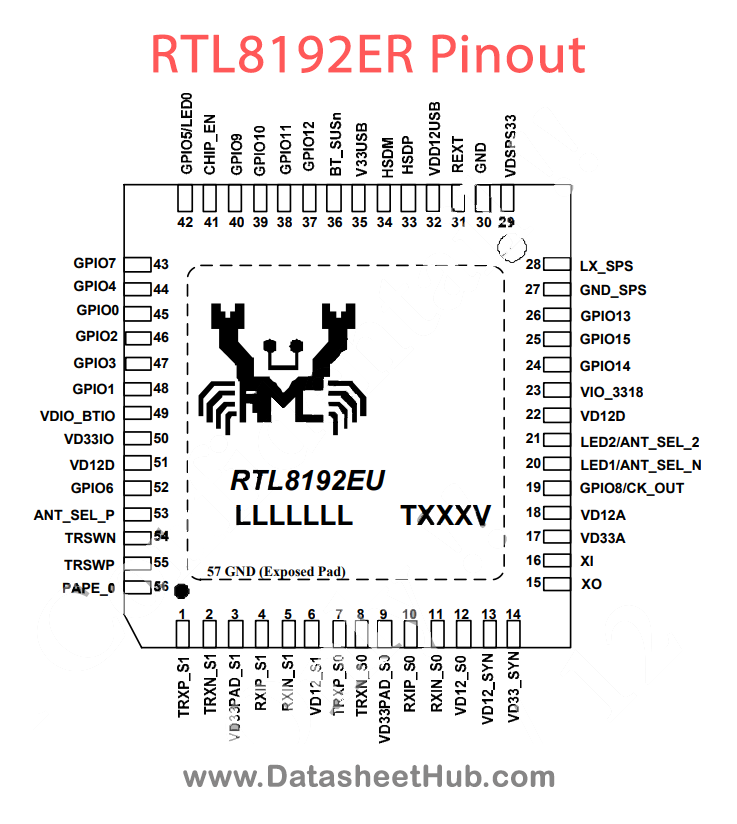
RTL8192ER pinout
RTL8192ER applications
- Wi-Fi Network Adapters
- Wireless Routers
- Wireless Access Points
- Wireless Bridges
- Wireless Print Servers
Comments 0
Leave a comment